
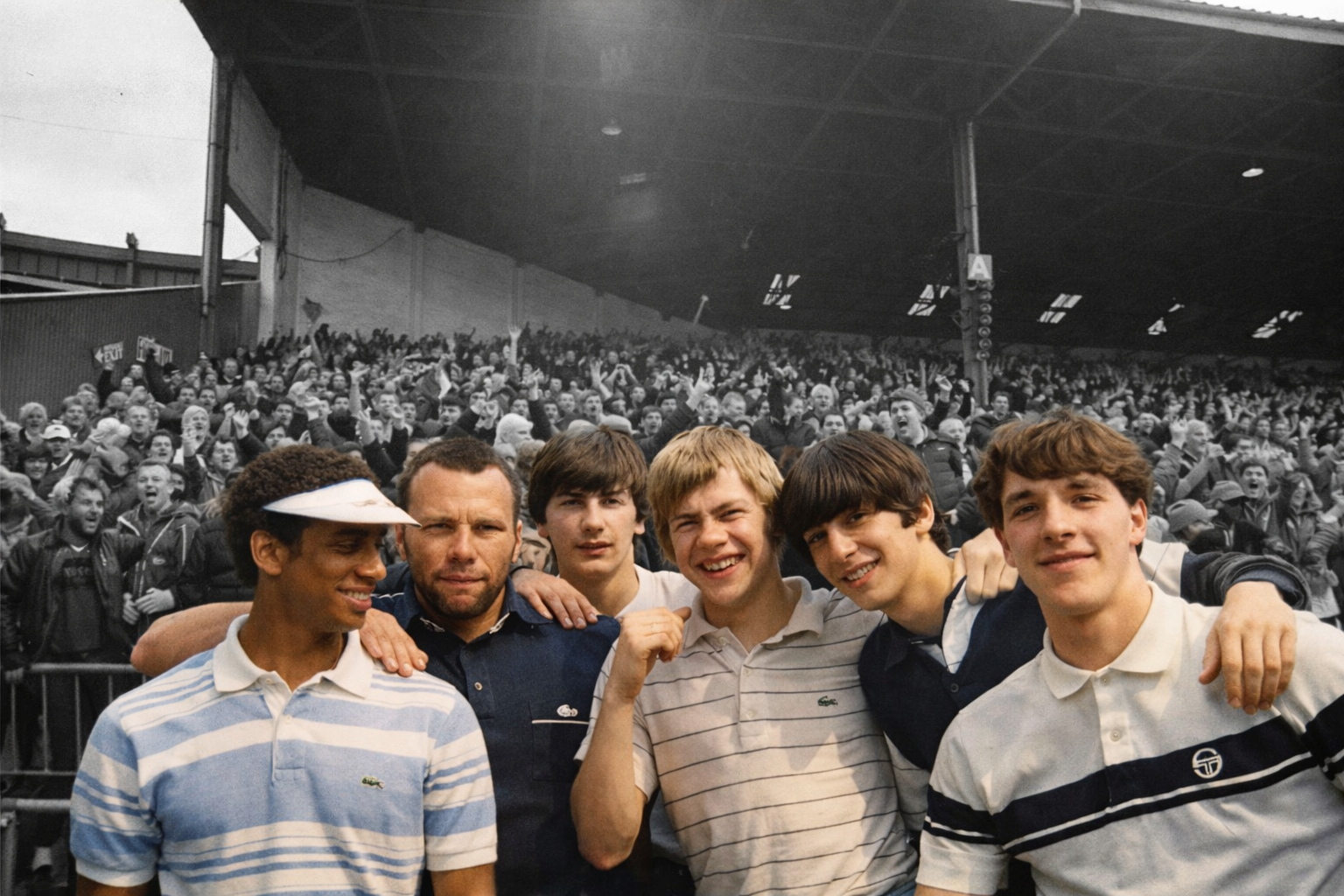
Most fashions of the 1980s have been endlessly recycled. Nostalgia has long since replaced creativity. But one style code still remains largely forbidden territory: the casuals.
Pringle jumpers. Sergio Tacchini and Fila tracksuits. Lacoste polo shirts and deerstalker hats. Kickers, trainers. Burberry, Fred Perry, Ellesse, Lyle & Scott. Cords with the seams split so they could splay over chunky trainers. It was a look both instantly recognisable and curiously resistant to revival.
The natural habitat of the casual was the football terrace. The style’s origins are usually traced back to Liverpool’s European campaigns of the late 1970s and early 1980s, when fans travelling abroad began shoplifting continental sportswear and wearing it back home. Italian and French labels became trophies, signals of status and belonging. What followed was the emergence of early-80s football hooliganism dressed in sharp, imported finery — a sleek visual contrast to the brute violence it often accompanied, and a rejection of the donkey jackets, denim and bovver boots worn by older fans.
Most casuals were soul boys, though there was a faction drawn to early hip hop and breakdancing. There certainly attempts at body popping at the rowing club disco. There was also overlap with the mod scene. A couple of mod mates grew out their French crews into asymmetric wedges and swapped parkas for Pringle knits. Both were working-class youth movements obsessed with dressing well and looking sharp. One of the earliest casual gangs — Manchester’s Perry Boys — emerged directly from the city’s mod and northern soul scenes.

The word “casual” itself first appeared in The Face magazine in 1983, but the wider media only caught on during the trial of the Cambridge Main Firm, a group of Cambridge United hooligans who gained national attention after violent clashes with Chelsea fans in 1985. The tabloids fixated on their expensive clothes — Pringle jumpers, designer denim, trainers — treating the style as a disguise rather than the point.
It still feels odd that Cambridge should have had a hooligan firm at all, but the casual scene was never just big-city. It was deeply provincial. Every town, every club — from Aberdeen to Plymouth — had its own hardcore casuals. Often different towns would have their own name for the style, making it hard to pin down.
By the mid 80s, every school playground had its contingent. Belmont was no exception. Not all the kit was genuine. My brother was rescued from school bullies by a mate of mine who promptly recruited him into selling snide Tacchini jumpers to his classmates.
Authenticity mattered — but so did simply looking the part.
What’s striking in retrospect is how little music the scene actually produced. Accent, an English new wave band from London, briefly embodied the look, even landing the cover of Sounds and playing at half-time at Chelsea FC to mark the club’s promotion back to the first division.

But Accent were essentially a mod revival band in different clothes.
For such a widespread movement, casual culture left surprisingly little original music behind. Its real musical legacy was indirect — compilations like Street Sounds, which introduced US electro, hip hop and urban dance music to the UK.
What the scene did produce in abundance was execrable football fiction — John King, Kevin Sampson — and films like Green Street, which flattened a complex subculture into a single note of testosterone and violence.
The true casual scene ended with acid house. Baggy Manchester fashions replaced Italian sportswear. The drugs changed, and so did the mood. Being loved-up became fashionable. Football itself became respectable — Fever Pitch, Newman and Baddiel, Football’s Coming Home. Blair brought Cool Britannia, but he also brought banning orders. All-seater stadiums, rising ticket prices, Sky Sports and the Premier League finished the job hooliganism started on itself.
Some former casuals drifted into far-right politics — the EDL, the Football Lads Alliance — which functioned less as movements than as fight clubs for coked-up muppets long since banned from football grounds. Some still turn up to Tommy Robinson marches to fight with the police.

The true stylistic legacy of the casuals is simpler and quieter: trainers becoming everyday wear rather than sportswear. Even that, of course, was borrowed — lifted wholesale from hip hop.
And perhaps that’s why the casual look still resists revival. It wasn’t nostalgia-friendly. It wasn’t ironic. It wasn’t playful. It was territorial, tribal, coded — a uniform worn by people who didn’t want to be looked at twice, but absolutely wanted to be recognised.
Some styles are best left exactly where they belong: on cold terraces, under floodlights, half-forgotten — and impossible to sanitise.
I used to read Sounds and remember Bushell mentioning Geezers at Oi gigs wearning Diamond Pringles and Farahs and not having a clue what he was on about. In Stafford ,there was a housing estate to help with the Liverpool overspill and it was only then did you see that kind of clobber when they went out in Stoke.
It was never so much of a football thing where I grew up. Football was still boots, donkey jackets and levis. It did have a cross over with gangs, each village and suburb had their own gang, which fought each other regualrly